

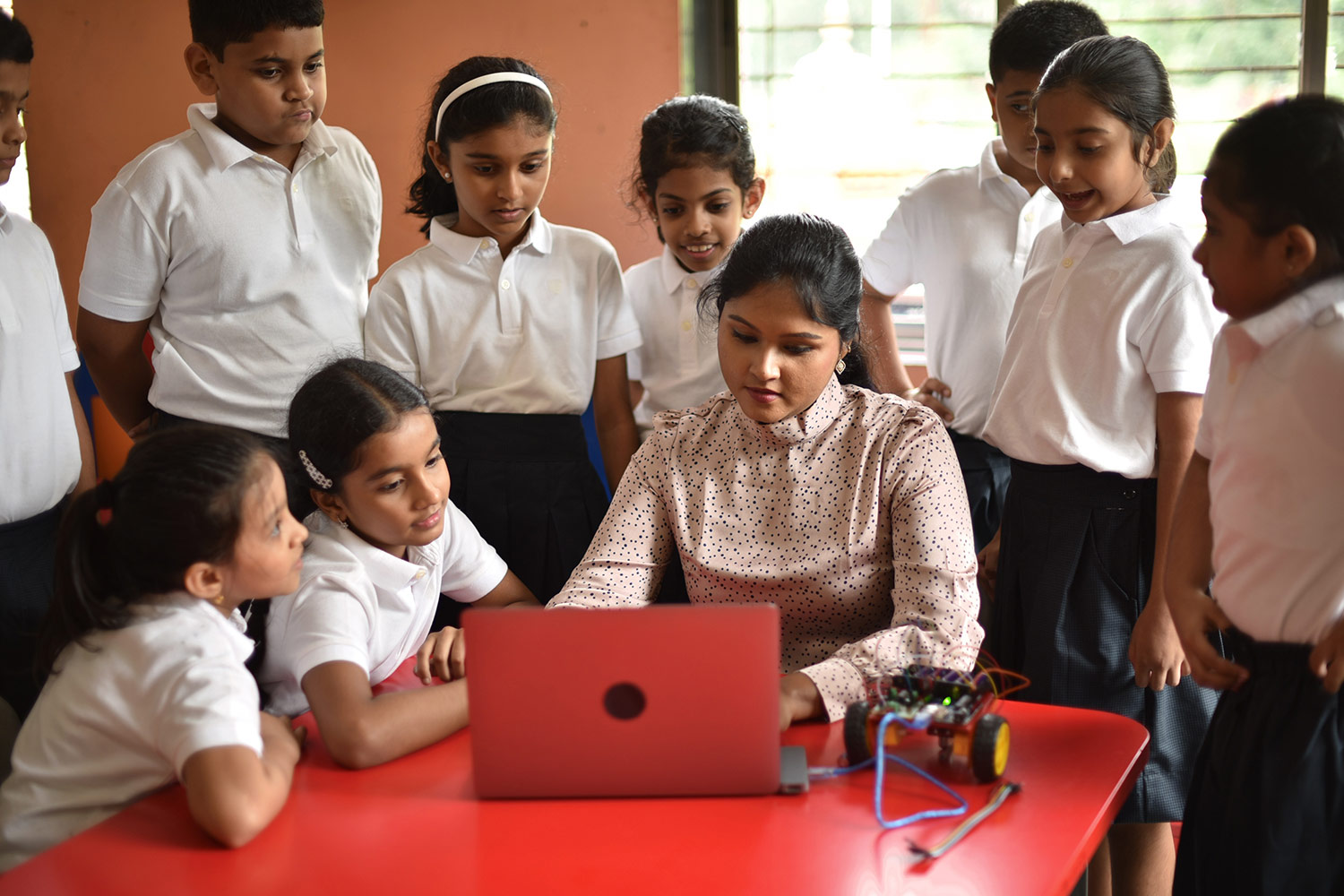
India’s education system is at a pivotal juncture. While decades of reform have focused on expanding access and scale, the defining challenge today is relevance. As artificial intelligence reshapes how knowledge is accessed, processed, and applied, the purpose of learning itself is being redefined. Education must now respond not simply by adopting new tools, but by reassessing what learning outcomes truly matter in an AI-shaped world.
Prosus, in collaboration with the Ministry of Electronics and Information Technology (MeitY), Government of India, convened Amrit Vidya: AI for Learning Advancement roundtable to explore AI’s transformative potential across India’s education ecosystem, with a sharp focus on improving learning outcomes, strengthening teacher enablement, and ensuring equitable access at scale. Bringing together senior policymakers, education leaders, and ecosystem stakeholders, the roundtable underscored the importance of aligning technology adoption with India’s educational and social priorities.
The Amrit Vidya dialogue forms part of a wider series of sectoral conversations spanning healthcare, agriculture, manufacturing, education, and governance, with insights contributing to a consolidated white paper to be presented at the Global AI Impact Summit. The education-focused discussion moved beyond abstract optimism around AI, to centre on clarity of purpose, measurable value, and the safeguards required for responsible adoption across India’s diverse learning environments.
The roundtable was co-chaired by Mr. Chandrasekhar Rentala, Chairman, Centre for the Digital Future; former Secretary, Government of India (IT & Telecom); and former President, NASSCOM, alongside Mr. Manit Jain, Co-Founder of The Heritage School and Former Co-Chair of FICCI’s School Education Committee – Arise. The dialogue brought together senior policymakers, education leaders, and ecosystem stakeholders, re-instating that education reform in an AI-first era cannot be driven by any single institution or sector.
Key perspectives were shared by Mr. Abhisek Singh, Additional Secretary, Ministry of Electronics and Information Technology (MeitY); Shri Anandrao V. Patil, Additional Secretary (PMPY & Digital Education Bureau), Department of School Education & Literacy; Mr. Alok Kumar, Chief Executive Officer, NSDC International; and Mr. Sehraj Singh, Managing Director – India and Vice President, Global Corporate Affairs and Public Policy. Together, participants explored how AI intersects with pedagogy, equity, employability, and governance within the Indian education context.
A central theme that emerged was the need to place purpose before technology. Participants emphasised that AI adoption in education must begin with a clear articulation of what learning outcomes India wants to prioritise. As Mr. Chandrasekhar Rentala observed, “The foundational challenge for India is enabling better learning outcomes at the school level. That first requires defining what those outcomes are—and how we measure them in today’s context.” In a resource-constrained environment, where significant increases in public education spending are unlikely, AI interventions must demonstrate tangible improvements in learning outcomes rather than serving as technological showcases.
Across sectors, AI adoption is accelerating, but education occupies a distinct position. What students learn today will shape not only their employability, but their ability to adapt, think critically, and navigate a future where roles, tools, and expectations are in constant flux. For decades, education reform in India has been anchored in syllabus completion and examination performance. However, AI has made one reality increasingly evident: content alone is no longer scarce. Understanding, judgement, and application are. The discussion underscored the need to move beyond rote learning toward cultivating adaptability, critical thinking, and lifelong learning—capabilities that will remain relevant even as technologies evolve.
The evolving role of teachers emerged as a defining theme of the dialogue. Far from diminishing their importance, AI was widely viewed as a force multiplier for educators. Reflecting on long-standing classroom constraints, Mr. Manit Jain noted that even with sustained investment in teacher capacity, personalising learning at scale has remained elusive. “The dream of meeting every child exactly where they are has always been difficult,” he said. “Today, technology has opened up infinite possibilities to finally realise that vision.” This shift from one-size-fits-all instruction to adaptive learning represents a structural change in how education can be delivered at scale.
Participants agreed that while AI may increasingly support the delivery of subject-specific knowledge, the human role of teachers will only grow in importance. As Mr. Rentala pointed out, “Specific subject knowledge may increasingly be imparted by AI, but teachers will remain mentors, facilitators, and guides—focusing on critical thinking, creativity, collaboration, and character-building.” In this framing, AI becomes a tool to reduce administrative load and enable more meaningful, human-centric engagement in the classroom.
Illustrating this transformation, Mr. Abhisek Singh highlighted how AI-powered tools can support learners who often fall through the cracks in traditional classroom settings. “Teachers often teach to the top 10% of the class,” he noted. “The average student, sitting in the middle rows, sometimes stops asking questions altogether. An AI tutor never gets annoyed—it keeps explaining until the student truly understands.” Such applications point to AI’s potential to complement teachers by offering personalised support without replacing human judgment or care.
Equity and access were underscored as non-negotiable considerations. Participants cautioned that without deliberate design, AI risks deepening existing digital divides. Highlighting on-ground realities, Shri Anandrao V. Patil emphasised that infrastructure gaps remain significant. “More than 40% of schools still lack reliable internet access,” he said. “It is not the child’s fault if they are born in a remote area—we must ensure technology bridges that gap, not widens it.” This perspective reinforced the need for state-led implementation and strong public digital infrastructure.
Language emerged as a powerful lever for inclusion. AI-enabled translation and multilingual content delivery were seen as transformative in a country as linguistically diverse as India. As Mr. Singh noted, the same learning content can now be made accessible across multiple Indian languages, dramatically expanding reach and comprehension. When combined with platforms such as DIKSHA, such tools can help democratise access to quality education.
The dialogue also examined how AI is reshaping the relationship between education and employment. As routine cognitive tasks become increasingly automated, traditional career pathways are being compressed and redefined. Reflecting on this shift, Mr. Singh observed that rigid academic labels may lose significance in the years ahead. “In the next five to ten years, rigid labels—science graduate, commerce graduate, law graduate—may matter far less than the ability to access the right information using the right tools,” he said. Instead, adaptability, AI literacy, and the ability to exercise judgment will define employability.
From a workforce perspective, participants stressed that AI literacy must be viewed as a foundational life skill rather than a specialised technical capability. Education systems must prepare learners not only to enter the workforce, but to navigate uncertainty, transition across roles, and remain resilient in an AI-augmented economy.
The Amrit Vidya roundtable concluded with a call for a phased, outcomes-led roadmap that integrates infrastructure development, teacher capacity building, multilingual content creation, and robust governance frameworks. Participants emphasised that India has a unique opportunity to chart a globally relevant model of inclusive, AI-enabled education—one that can serve as a reference point for other low- and middle-income countries.
Mr. Rentala reflected, “Many countries are looking to India for leadership in digital innovation—not just for ourselves, but for low- and middle-income economies navigating similar challenges.” Getting education right in an AI-first era is not only about preparing students for future jobs—it is about shaping how a generation learns to think, question, and contribute long after specific technologies have evolved.
From a Prosus perspective, the dialogue underscored that real progress will depend not just on technological capability, but on the willingness of institutions, policymakers, and ecosystem leaders to rethink long-held assumptions and collaborate across boundaries. Mr Sehraj highlighted, “We believe India’s AI moment cannot be approached through inherited assumptions or incremental thinking. The opportunity ahead is not about replicating global models, but about forging a distinctly Indian path—one that is ambitious, inclusive and grounded in our realities. We must be willing to challenge each other, invite diverse perspectives and design for long-term impact. This roundtable is a starting point—an invitation to collectively raise the temperature, ask harder questions, and build an ecosystem that enables India to lead, not follow, in the years ahead.”