
20 Founders · 5 Days · 3 Cities · Shenzhen · Shanghai · Beijing
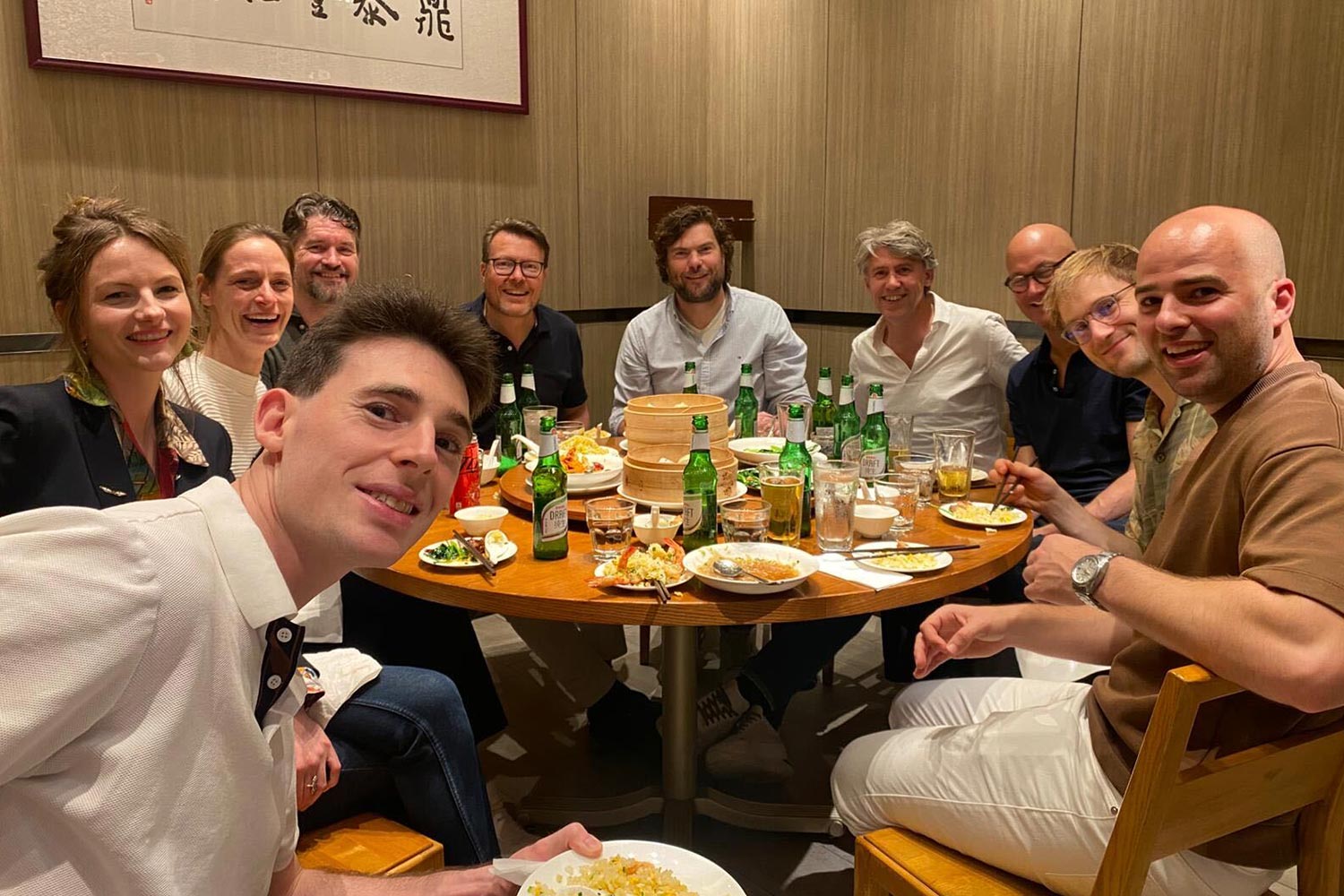
In April, Prosus took 20 tech founders to China to see the AI ecosystem up close.
The premise was simple: in a world that’s polarising fast, curiosity is a professional advantage. The founders who understand what’s actually happening in China — not the caricature, not the cold-war framing — will make better decisions than those who don’t.
What nobody fully anticipated was how quickly the encounter would stop being about China.
Watch what they learned in our short film
GOING IN
What they thought they’d find
Almost everyone arrived with the same mental model. China: state-driven. Cheap copies. Cautious VCs pulling back. The phrase someone used on day one — “China is AliExpress” — captured the collective assumption well.
Shenzhen answered that within hours. A city that was a fishing village thirty years ago now posts a GDP of $550 billion — larger than Portugal’s entire economy. Three storeys of new construction, every week. A taxi driver pulling out a translation app mid-conversation. That pace isn’t policy; it’s instinct.
By the end of day one, three founding assumptions had already broken:
|
State-driven |
→ |
Hyper-competitive entrepreneurship inside state-set lanes |
|
Copying |
→ |
Originating |
|
Ahead in technology |
→ |
Ahead in deployment |
“The moment I felt behind? That was the day. The moment I arrived here.”
CONSTANTIJN VAN ORANJE-NASSAU · TECHLEAP
THE REAL FINDING
The window becomes a mirror
The real finding wasn’t China’s technology. It was the attitude behind it.
“In Europe, new is risk. Here, new is chance.”
HENDRIK SANDER · NEOTASTE
The phrase that kept surfacing — in different forms, from different founders — was what Alessia Sinzger from DLD called ambition density. Not talent density. Not intelligence density. The density of ambition.
It operates at four levels simultaneously. Any single ring is replicable. The compounding across all four is what’s hard.
| INDIVIDUAL | FAMILY | COMPANY | COUNTRY |
|---|---|---|---|
|
“They actually do it. They go, they iterate, they start.” — Joris |
$4,000 average household income underwriting a $40,000 CS degree. |
“Every blue ocean turns red incredibly fast.” — Timo |
“Socialism that uses capitalism to the max.” — Constantijn |
THE TECHNOLOGY PICTURE
What the technology gap actually is
China’s AI isn’t categorically more advanced. The models are becoming commoditised — DeepSeek-V3 trained for roughly $5.6 million versus hundreds of millions in the West. Lab cultures are radically flat: no KPIs, no layers, small teams of elite engineers shipping at startup speed inside large organisations.
Where China pulls ahead is in deployment, wrapping, and distribution. Five platforms — Alibaba, Tencent, ByteDance, Meituan, Baidu — each with hundreds of millions of users, each with an AI layer plugged directly into daily commerce, messaging, and local services.
|
1.4B Tencent ecosystem users |
$5.6M DeepSeek-V3 training cost |
300M Alibaba AI platform MAU |
“Models are exchangeable. Build the agent layer.”
TIMO BOLDT · GOUSTO
The technology gap is still closeable. The attitudinal and ecosystem-assembly gap is the harder one.
THE QUESTIONS
The questions that followed them home
Not everyone left with answers. Alvaro Martínez from LucIA put it plainly: “I wrote almost 40 pages. I still don’t have the top lessons. The experience has been so huge I don’t really know yet.”
That honesty felt worth preserving. The temptation after a trip like this is to package everything into five tidy takeaways. The founders who sat with the discomfort a little longer came back with sharper thinking.
“Europe has the most advanced AI regulation and the least AI.”
JORIS BECKERS · PICNIC
“Will we have a seat at the table, or will we be on the menu?”
ALESSIA SINZGER · DLD
Both are genuine questions, not rhetorical ones. The answers depend on what happens next.
NEXT STEPS
Closing the gap — starting Monday
FOR FOUNDERS
- Ship faster — Not incrementally faster. Think days, not quarters. Iterate in public.
- Build the agent layer — The model debate is a distraction. UX and distribution is where this gets won.
- Try the Chinese stack — Most founders on the trip hadn’t tested Genspark, Moonshot, MiniMax, or DeepSeek before arrival. Most plan to now.
- Find a purpose worth hunger — The work ethic isn’t transferable, but a galvanising mission is.
FOR POLICYMAKERS
- Send delegations to Shenzhen — Not just Silicon Valley — see execution at scale.
- Build vertical strategic plans — AI, robotics, quantum, advanced manufacturing — sector by sector.
- Kill intra-EU fragmentation — 27 regulatory regimes is a competitive handicap from another century.
Bring the whole population along — The warehouse manager who sees automation coming has to be part of the conversation, not an afterthought.
Thank you to everyone who joined.
Twenty founders who chose curiosity over comfort. Their openness made this possible.
|
DLD |
QONTO |
LUZIA |
GOODHABITZ |
|
SILVERFLOW |
ZOOP |
TECHLEAP |
COOLBLUE |
|
SHOPPER |
NEOTASTE |
ADVOLVE |
TRANSFERZ |
|
PICNIC |
EQUAL |
SYNKAR |
ZAPIA |
|
SENDCLOUD |
GOUSTO |
DATASNIPPER |
On staying curious
The world is polarising. Borders are hardening, narratives are simplifying. In that environment, the easiest thing is to stop paying real attention to what’s happening on the other side.
At Prosus, we think that’s precisely the wrong instinct. Curiosity isn’t idealistic — it’s strategic. The founders who go and see for themselves, who resist the prevailing story long enough to question it, make better decisions. They build better companies. They ask better questions.
This documentary isn’t a competitive analysis. It’s an invitation to look honestly at a different way of building — and then turn that lens on yourself.
The technology gap is real but closeable. The ambition gap deserves more honest attention than it usually gets. The first step is simple: stay curious. Go see. Come back different.