
Prosus Open Source Products
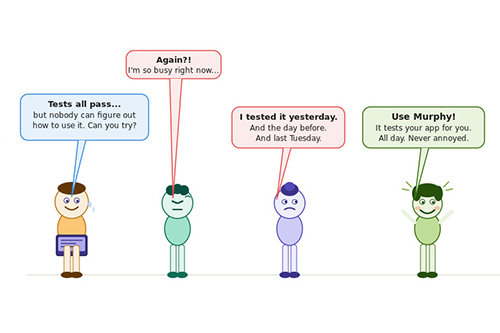
If you’ve built a product, you’ve tested it. You've run the checks, everything passes, and the results look good – time to launch. And yet, a first-time user lands on your page, completely misses the "New" button in the sidebar, clicks something random, submits an empty form, gets zero feedback, and quietly leaves. Nothing in your testing process caught it, because nothing was designed to.
Our experience building AI-powered products for some of the world's largest food delivery, travel, and on-demand service marketplaces means we know this problem well – and recognise that the tools to catch it before it happens don't exist yet. Traditional automated tests are built to check whether the button works, not whether people will actually find and use it.
That's why we built Murphy: an open-source AI agent that evaluates your product the way real users would.
Who Murphy is built for
Murphy works for product teams who want honest UI feedback without recruiting testers, QA engineers who want to complement their existing suite with experience-level issues that functional tests miss, and solo builders who want to ship with confidence without a dedicated QA team. Point it at a URL and it returns a structured report with findings, verdicts, suggested fixes, and a visual dashboard you can share across the team.
How Murphy works
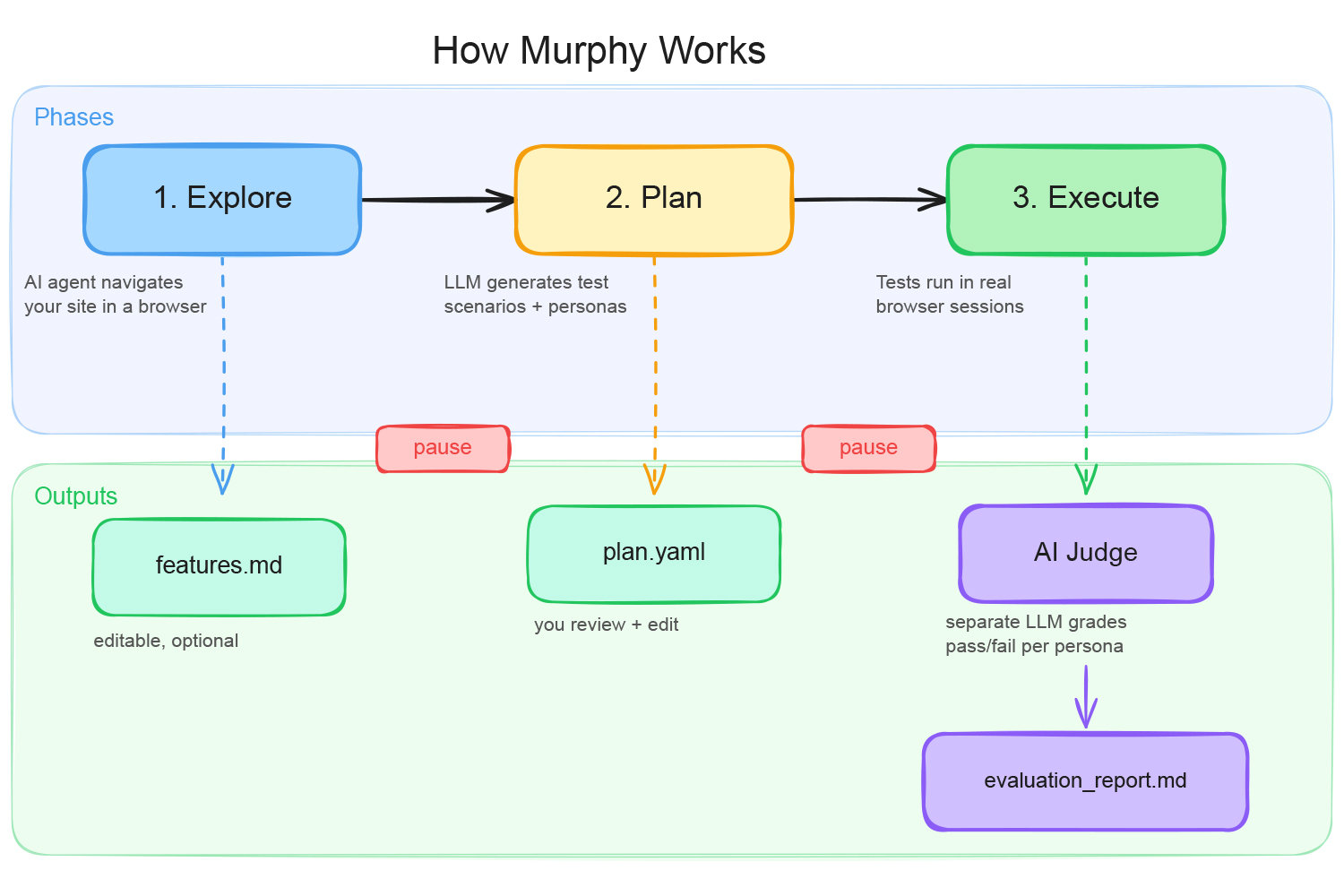
Murphy runs in three phases:
- Explore: Murphy navigates your site like a curious new user, clicking through pages and discovering features. Run it without a goal for a broad sweep of your whole product, or point it at a specific flow (like checkout or sign-up) to focus the exploration there.
- Plan: Based on what it finds, Murphy generates a set of test scenarios with clear steps and success criteria. You review and edit before anything runs.
- Execute: Tests run across multiple browser sessions simultaneously, each playing a different user persona. A separate AI judge reviews what actually happened and decides whether the test passed or failed.
What Murphy tests for
Murphy evaluates the full experience, from the moment a user lands on your page to the moment they complete or abandon a task. It assesses discoverability and feedback quality, error handling and flow completion, and how your product holds up when users do something unexpected. Crucially, what counts as a pass depends on the persona: a low-patience user needs a fast response; a low-literacy user needs visual feedback, not buried text.
Designed for every type of user
We designed Murphy with ten built-in personas, each bringing distinct behaviours, tolerances, and expectations: from a happy-path user who follows instructions exactly, to a confused novice who skips them entirely, an impatient clicker who abandons anything slow, and several others in between. Each persona is scored across trait dimensions – technical literacy, patience, reading comprehension, visual preferences – that together shape how it behaves and what a passing result looks like.
Murphy can also build personas directly from your real users. Connect PostHog and it will analyse actual sessions, identify behavioural patterns, and generate custom personas that reflect how your audience actually behaves. As your user base evolves, your tests evolve with it.
Open Source and Available Now
Murphy is free to use and openly available:
- GitHub: https://github.com/ProsusAI/Murphy — source code, documentation, and sample evaluations
- Engineering blog: Read the technical deep dive — architecture, personas, and a step-by-step walkthrough
Murphy is an open project, and contributions are welcome from anyone working in this space: whether that’s building AI products, running a QA team, or shipping software you want people to actually be able to use.
At Prosus Forward, our first-ever global technology showcase, we announced several open-source tools that we’ve built to power agents across our ecosystem. We’re sharing these with the wider developer community because we believe the best products are built with honest feedback, and we invite developers everywhere to explore, use, and contribute.