

Prosus Open Source Products
AI assistants can answer almost anything, but ask them what you said last week and they have no idea. We built a memory system that changes that.
Our food delivery, travel, and ecommerce platforms help our one billion customers buy, sell and transact every day – and increasingly, those users expect those brands to know them. As brands move from single-session chatbots towards AI assistants that serve customers across multiple interactions over time, one capability has become essential: memory.
Not the kind of memory that only recalls what you said two minutes ago, but the kind that builds up over weeks and months, learning your preferences, remembering your past experiences, and using that knowledge to serve you better every time. That’s why we built MemEval, a way of measuring assistants’ memory performance, and then used that to develop PropMem, a memory system capable of the long-term recall that users will come to expect from their AI assistants.
The Problem
Today’s AI assistants are impressive in a single conversation. But the moment that conversation ends, most of them forget everything. Each new interaction starts from zero.
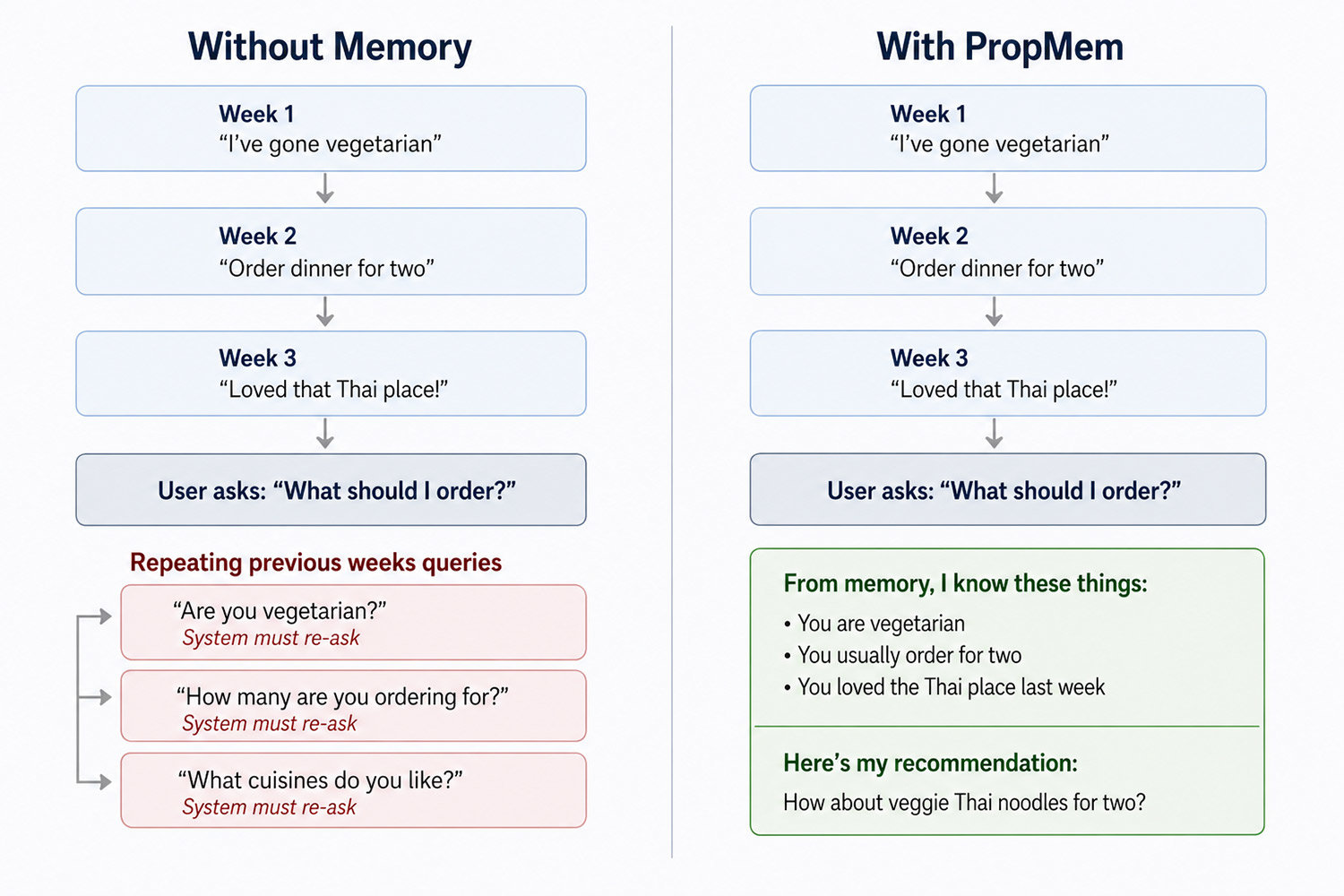
For Prosus’s ecosystem platforms, this is a real limitation. Consider an assistant on iFood, the leading food delivery business in Brazil. A truly useful assistant wouldn't just help you place an order today. Over time, it would learn that you're vegetarian, that you prefer spicy food, that you usually order for two on Friday evenings, and that you tried a new Thai place last month and loved it. It would know not to suggest the restaurant that delivered your food cold last time, and if you mentioned you're trying to eat lower-carb this month, it would remember that too, adjusting its suggestions accordingly.
This is the kind of experience that turns a basic chatbot into a helpful personal assistant. But it only works if the assistant can remember things reliably, across conversations, over time, at scale.
Many AI memory systems exist today, but until now, there hasn’t been a reliable way to compare them. Each one tests itself under different conditions with different scoring, making the results almost impossible to compare.
What We Built
We built two solutions.
- MemEval: a testing framework that puts different memory systems through the same set of conversations and questions so their results are directly comparable.
- PropMem: the top-performing memory system we designed for the kind of long-term recall that personal assistants need.
One popular way of learning about customers is to store all the data from a single user interaction, and to add data every time that user interacts again with an online service. The problem is that, over time, you’re duplicating and including information which is not insightful. This approach can result in dozens or even hundreds of pages of user interaction data being used to inform a single user interaction. Storing full conversations may work at a small scale, but it quickly becomes inefficient across a large number of users.
The key idea behind PropMem is simple: at scale, it’s easier to remember a short list of pertinent facts than a long list of conversations. PropMem distills every conversation into a set of pertinent facts about a user, which it updates every interaction. By extracting and storing only the pertinent facts, it builds a concise, structured record of user preferences and behaviours. This makes retrieval faster, more compute-efficient, and more accurate. It means users don’t have to repeat themselves, and platforms don’t need to rebuild a customer profile from scratch with every new session.
In practice, this means that when a customer tells their AI assistant they’re hungry, the assistant can immediately make informed suggestions based on their preferences and past experiences, even adapting the language of the interaction. When the same customer later mentions they've gone vegetarian, PropMem stores it as a new pertinent fact that replaces their previous dietary preferences, so suggestions stay up to date and personalised.
With MemEval, we tested nine different memory approaches using the same conversations and questions across all systems. We tested whether each system could recall simple facts, understand timing, connect information across different conversations, reason about what it knows, and handle difficult questions designed to trick.
PropMem emerged as the top performer, delivering the most accurate answers while using significantly less processing power than other approaches.What This Means for Our Platforms
Memory is what separates a chatbot you tolerate from an assistant you actually want to use. PropMem is already live at Prosus corporate and through Toqan for Restaurants, where it remembers dietary preferences, ordering patterns, and past experiences to help assistants make relevant recommendations straight away — no repeated questions, no starting from scratch.
In a matter of weeks, we’ll release PropMem to companies across the Prosus ecosystem, opening up real possibilities:
In travel, an assistant that knows your seating preferences, loyalty programmes, and travel habits can handle bookings with minimal back-and-forth, getting smarter with every trip you take.
In customer service, an assistant that remembers your previous issues can pick up where you left off, instead of making you explain the same problem you’ve had previously from the beginning.
In each case, the experience improves because the assistant actually knows you.
Open Source and Available Now
Both PropMem and MemEval are freely available. We're sharing them because we believe the best AI infrastructure is built collaboratively, and because better memory for AI assistants benefits everyone.
- GitHub: github.com/ProsusAI/MemEval
- Technical deep dive: Engineering blog on Medium
We welcome contributions from anyone working in this space, whether you're building AI assistants, running a platform, or exploring new approaches to memory.
At Prosus Forward, our first-ever global technology showcase, we announced several open-source tools built to power agents across our ecosystem. We're sharing these with the wider developer community because we believe the best AI infrastructure is built together, and we invite developers everywhere to explore, use, and contribute.