

At Prosus, we build AI-powered products for some of the world’s largest food delivery, travel, and on-demand service marketplaces – reaching more than one billion customers across Latin America, Europe and India. Our scale gives us a good view of what's coming next for ecommerce: a single, unified agentic interface – known as a life assistant – that can access multiple services on a user's behalf, eliminating the need for many apps with their own bespoke agents.
We see this shift coming, but it only works if there is a common language through which multiple marketplaces and agents can seamlessly communicate with each other. That’s why we built the Agentic Services Protocol (ASP) – an open-source protocol that standardises how agents communicate with live-service platforms.
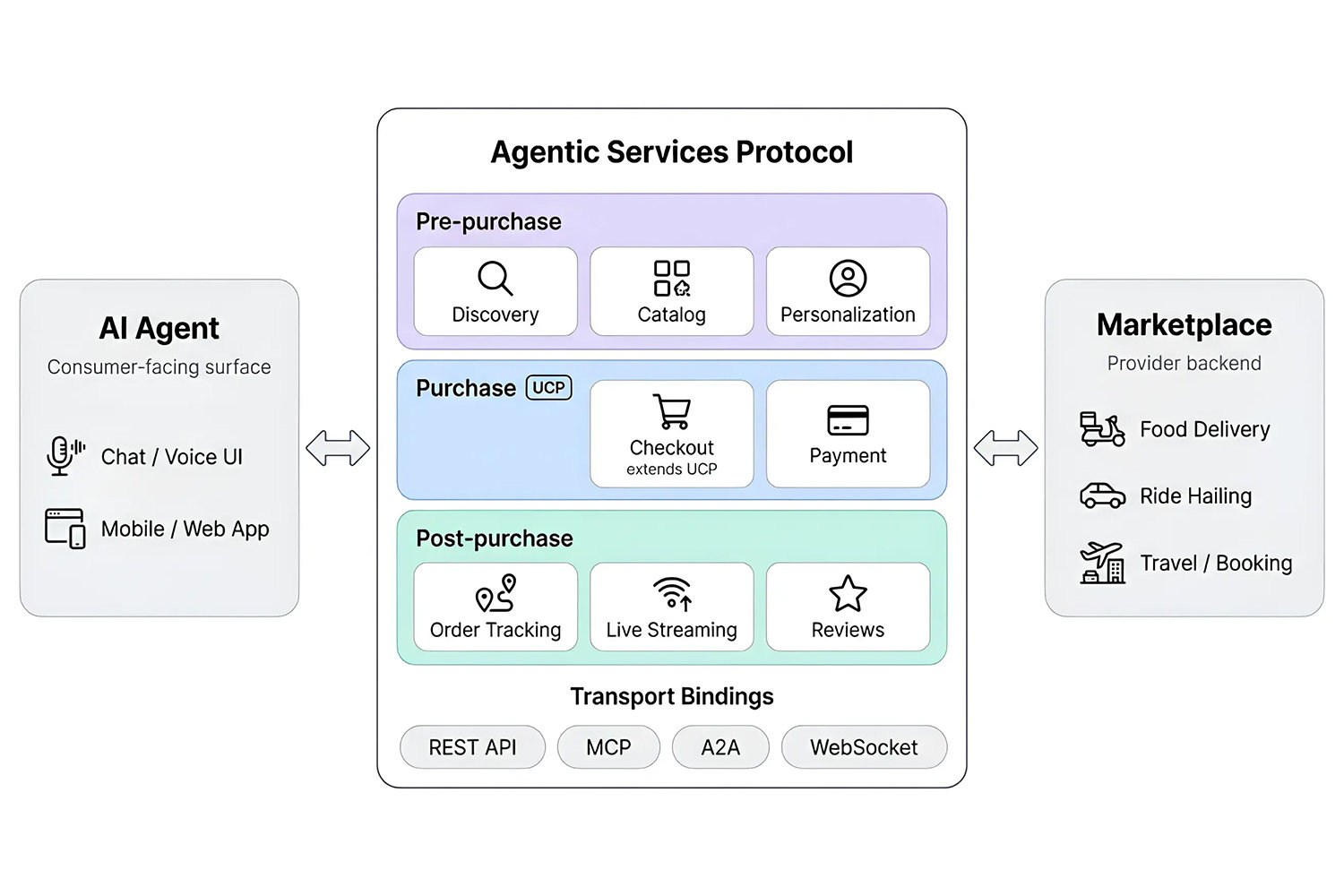
ASP builds on top of Google's Universal Commerce Protocol (UCP) — an existing open standard for online shopping. Where UCP handles the basics of browsing, and the majority of the checkout experience, ASP adds what’s needed for real-world services; things like delivery fees, tipping and scheduling a time slot.
The Problem
Modern ecommerce was built for humans manually navigating multiple apps. The next shift is a life assistant that unifies services and completes tasks for you.
Imagine a personal AI companion on your phone. You ask it to "book a ride home" or "order a healthy dinner," and it gets to work, already knowing your needs and preferences – browsing live menus, comparing prices, checking availability, and handling details like tipping and special requests, across every platform, in one conversation.
The problem is that the infrastructure to enable this doesn't exist yet. Each platform structures its menus, pricing, and availability differently, and without a common language, every marketplace has to build its own integration for every AI agent – and vice versa. That means slower progress towards agentic ecommerce, and fewer services that your life assistant can help you with.
ASP solves this. It’s the shared language between agents and marketplaces. Once a platform adopts it, any agent can work with it – no custom integration needed.
Who ASP is built for
- For marketplaces and service providers: Marketplaces integrate once, and every AI agent speaking ASP can work with them – without relinquishing control of their pricing, data, or customer relationships. ASP ensures information flows reliably between platforms and agents.
- For AI agent builders and platforms: ASP provides a ready-made foundation. Instead of building a separate connection for every marketplace, they can plug into one common standard that already works across food delivery, ride-hailing, travel, and more.
- For consumers: With ASP, your life assistant will handle all your online buying needs – browsing through marketplaces, finding the right option, placing the order, and tracking it in real time – from a single app.
- For payment providers: Nothing changes. ASP connects to existing payment infrastructure (UCP), so systems and payment methods continue working as they do today.
What ASP unlocks for consumers
ASP standardises the whole journey, from the moment you ask your life assistant for something, to the review you leave afterwards. Here’s what that will look like:
| Capability | What your life assistant does |
|---|---|
| Discovery | Your life assistant searches nearby options based on what you want, where you are, and what’s available right now. |
| Catalogue | It browses menus, listings, or services, including prices, photos, dietary info, and customisation options. |
| Fulfillment | It handles checkout, including delivery fees, tips, loyalty discounts, and schedules a time that works for you. |
| Order Tracking | It follows your order through every stage and lets you know if there are any delays. |
| Live Streaming | It tracks your delivery or ride in real time, so you always know where things are. |
| Personalisation | It remembers your preferences, past orders, and dietary needs – and can surface offers tailored to you. |
| Reviews | After the service, it lets you leave a rating and feedback. |
Designed for multiple industries
We designed ASP to work across multiple industries. The same standard works whether your life assistant is ordering you food, booking a ride, or reserving a hotel room. For industries with specific needs, ASP includes examples of Domain Profiles, which show how to extend the existing standard with tailored add-ons:
- Food delivery: Tracks your order through the kitchen, handles ingredient swaps, and supports dine-in.
- Ride-hailing: Covers vehicle types, surge pricing, and driver details.
- Travel: Covers room amenities, cancellation policies, and check-in/check-out windows.
And if an industry doesn’t have a tailored add-on yet, ASP still works, meaning your life assistant can handle the basics from day one.
What's next
ASP continues to evolve. Upcoming additions include multi-provider carts – so a life assistant can combine orders from different platforms in a single request – new Domain Profiles covering groceries, pharmacy, home services, and support for subscriptions. The full roadmap is available in the documentation.
ASP is a step toward a future where a life assistant can handle all your everyday services, regardless of which platform provides them. No more switching between apps, no more re-entering preferences, no more managing five different accounts. Just tell your assistant what you need.
Open source and available now
ASP is free to use and openly available. The full specification and working examples are available below:
- Documentation: Full protocol documentation, schema authoring guides, and implementation checklist
- GitHub: Source schemas, transport specs, and type generation
- Sample Implementations: Working demos for food delivery, ride-hailing, and travel
ASP is an open project, and contributions are welcome from anyone working in this space – whether that’s building AI agents, operating a marketplace, or developing commerce infrastructure. Visit the GitHub repository to get involved, or read our engineering blog for a technical deep dive into the architecture, schemas, and a step-by-step integration walkthrough.
At Prosus Forward, our first-ever global technology showcase, we announced several open source tools that we've built to power agents across our ecosystem. We're sharing these with the wider developer community because we believe the best AI infrastructure is built together — and we invite developers everywhere to explore, use, and contribute.