New research from one of the world's largest builders and operators of AI agents offers a hype-free deep-dive into scaling agentic AI – and a roadmap for the organisations yet to make the leap.
Prosus spent the last eighteen months building AI agents at a scale few organisations anywhere in the world can match. Across its global portfolio of companies, its 40,000 employees have now deployed over 60,000 agents – giving it a uniquely practical vantage point on what works, what doesn't, and what the future of agentic AI looks like in practice.
Today Prosus is sharing everything it learned in a first-of-its-kind report, The Coming Age of AI Colleagues. The report acts as a practical playbook for organisations seeking to scale agentic AI: why just 2% drive the vast majority of business impact, why companies across different industries and geographies keep building the same 20 use cases, how to move from experimentation to enterprise-wide adoption, and where the technology is heading next.
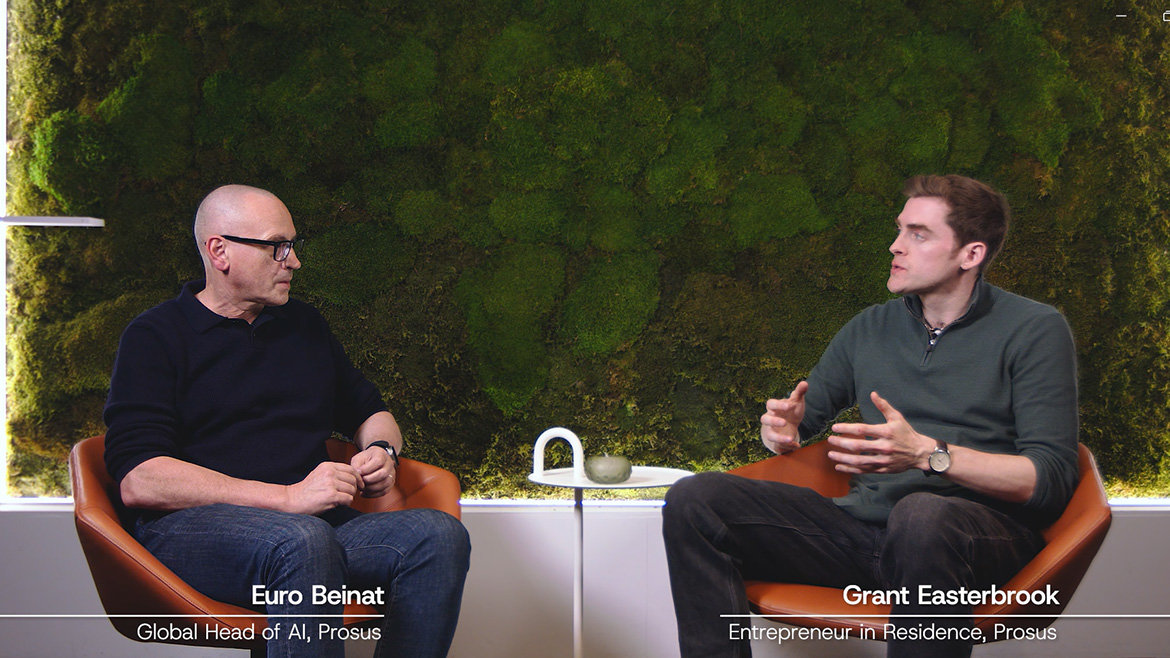
Euro Beinat, Global Head of AI at Prosus, said: “There is no shortage of predictions about what agentic AI will do to business. But there is a real shortage of hard evidence about what it is actually doing right now – this report is our attempt to fill that gap and with the data to back it up.
“What surprised us most was the consistency: across entirely different businesses, in different countries, building for different customers, our portfolio companies kept building for the same 20 ‘power law’ use cases. While not a comprehensive list, these 20 AI agents are a good starting point for all organisations to implement – and a window into what will likely become 'default AI' for every business within the next few years.”
The report reveals a series of patterns and insights that emerged from analysing Prosus's 60,000-strong agent base:
- The classic business “power law” holds true for AI agents: Approximately 2% of active AI agents drive a disproportionate share of business impact. The first priority for any organisation is to identify and double down on those agents, using data-driven analysis to spot others trending in the same direction.
- Companies kept building the same 20 power-law use cases: Across different industries, geographies, and languages – and with no mandate from Prosus HQ – portfolio companies consistently converged on the same 20 agentic AI use cases, each delivering a strong, immediate ROI.
- AI agent complexity maps to human seniority levels: Agent complexity falls into four tiers that closely mirror human employee seniority levels. While senior-level agents have the largest total user base, daily usage splits almost evenly between senior and junior agents — revealing that simpler AI agents carry significant weight in everyday tasks.
- Data analytics and personal AI assistants dominate: Across 54 distinct AI agent tasks identified in the report, data analytics and market intelligence claimed the largest share at 18%, followed by operations at 15%. Notably, 14% of agents sit outside any formal department, representing employees' personal AI assistants.
- Productivity gains range from modest to extraordinary. The majority of productivity agents (82%) deliver under 20 hours saved per month. A middle tier (17%) saves between 20 and 173 hours monthly. A tiny fraction — less than 1% of agents — operate at an entirely different scale, delivering the equivalent of thousands of hours of work per month.
- A small number of agents deliver transformative financial value. Most value agents deliver under $1M in annual value, but a small number of outliers deliver in the tens of millions. One portfolio company used AI agents to manage communications and onboarding for a new third-party affiliate marketplace – a business projected to generate $83M in annual revenue.
- Most AI models are now 'good enough' – but users resist switching. Cutting-edge models are only needed for the most complex tasks. However, users are reluctant to switch models once an agent works, creating a cost challenge: organisations may find themselves using unnecessarily expensive models for tasks that cheaper alternatives could handle just as well.
Looking ahead: the rise of autonomous AI-enabled organisations
After scaling to 60,000 AI agents, Prosus has a clear view of what an AI-driven organisation looks like in practice – and what the future holds. Implementing AI within existing structures is just the beginning. The deeper transformation lies ahead: autonomous, AI-enabled organisations where sales, operations, and customer support are coordinated by networks of AI systems built around outcomes, not org charts.
The Coming Age of AI Colleagues report is available here to download.