
Dive into our worlds – Rajesh Elangovan
Every week, after work, you’ll find me on a cricket field, coaching youth players at one of the largest cricket clubs in the Netherlands.
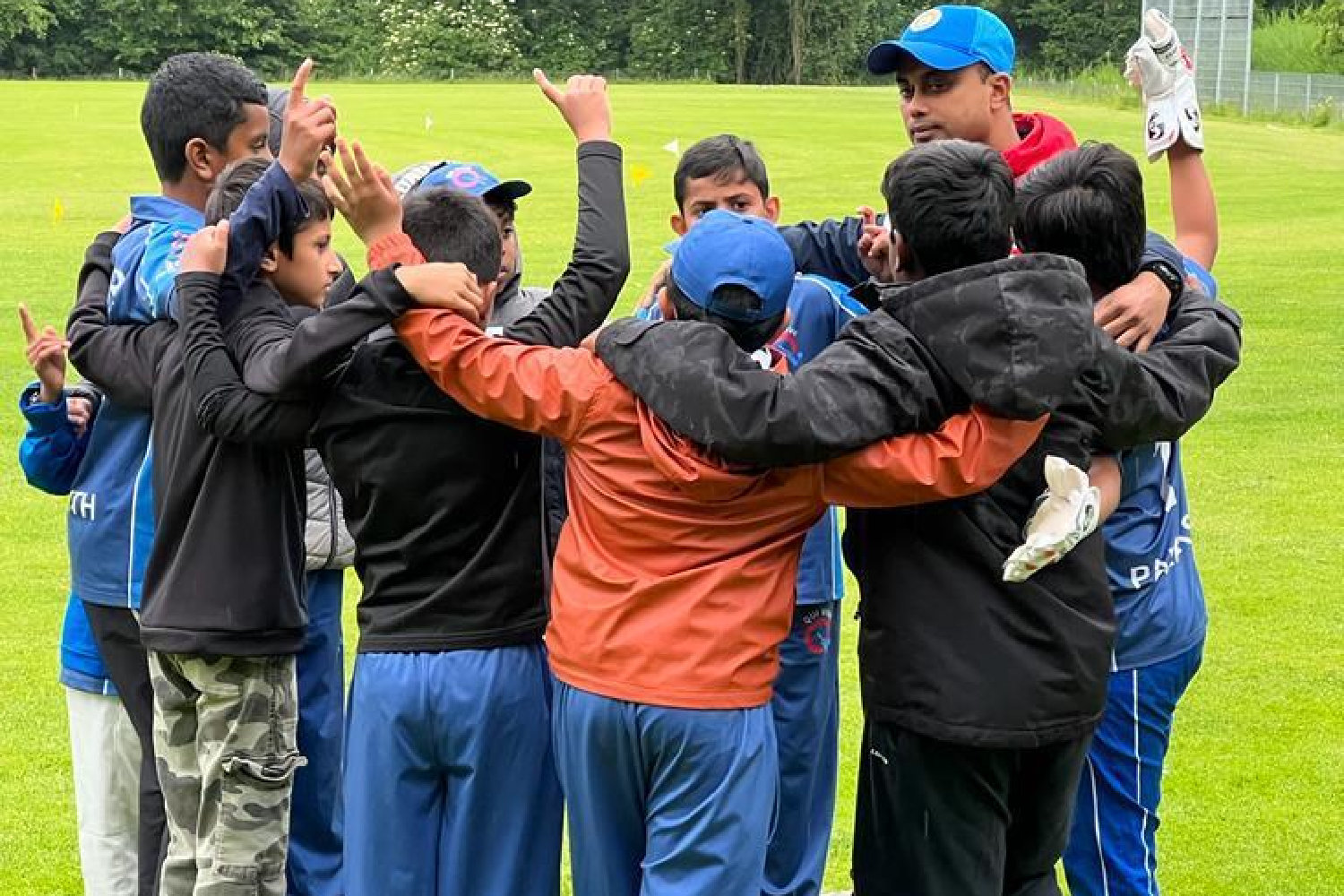
Where it all starts: The weekly huddle at the Cricket Club.
And every week, I see the same thing I first saw twenty years ago in Chennai, India where I grew up and played elite youth cricket.
The most talented player is almost never the one who grows the most.
The one who grows the most is the one who listens. Who asks questions. Who takes feedback without ego, fails, and comes back the next week to try again.
I didn’t know it then, but that observation would end up shaping my entire career – and, eventually, how a global company of 40,000 people learns AI.
The pattern I couldn’t unsee
People sometimes ask me for the exact moment the lesson clicked. One player, one match.
Honestly? There wasn’t one.
It was a pattern I kept seeing, season after season. Talented players who plateaued. Less obvious players who kept travelling further, because they were open, curious, never satisfied.
"Talent isn't performance – it's coachability. Performance tells you what someone can do today. Coachability tells you how far they might travel."
Sport teaches you something else, too: nobody ever got better at cricket from a PowerPoint.
You get better by practising. Getting feedback. Applying it under pressure. Repeating.
I fell into learning and development almost by accident at the start of my career. But I fell in love with it, because it was the same puzzle at a different scale: how do you help someone become capable of something they couldn’t do before?
Scale teaches you humility
I spent more than fifteen years at another company that had around 400,000 people. The project that brought me to the Netherlands, fourteen years ago, was a transformation across the whole of EMEA. Roughly 70,000 people.
The Chief Learning Officer asked: are you up for the challenge?
I said yes, why not.
That’s where I learned that scale teaches you humility. You can build a brilliant programme centrally and watch it change nothing locally. We once rolled out a global sales transformation built on all the right theories and quadrants. Beautiful content.
Not a single metric moved.
Because we had made it generic. And generic doesn’t change behaviour – context does. Practice does. Meeting people the way they actually learn does.
I’ve never forgotten that failure. In a strange way, I’m grateful for it.
The company I had to research
When Prosus approached me three and a half years ago, I’ll be honest: I had to look up what the company was.
What I found fascinated me. Not one industry, but many – food delivery, fintech, classifieds – across continents and cultures, all in one ecosystem. After a career inside one sector, this was a bulb moment: how much could I learn here?
It’s still the best decision I’ve made.
Because then came the ambition that changed everything: becoming an AI-first company. And with it, a leadership mindset I’d never experienced before – never fear taking a risk. Never be afraid to experiment.
Talent transformation suddenly sat at the epicenter of the whole company. And I had a lifetime of thinking about coachability ready to use.
“Just” 30,000 agents
The first target was 10,000 AI agents – set while much of the industry was still debating what an agent even was.
We hit it within weeks. So leadership tripled it: 30,000.
Baffling, at first. Then, on the drawing board, the reframe that unlocked everything:
We have 40,000 people. What if everyone builds just one?
One agent that drafts your email responses. One that tracks your budget. Suddenly the mountain looked like a staircase.
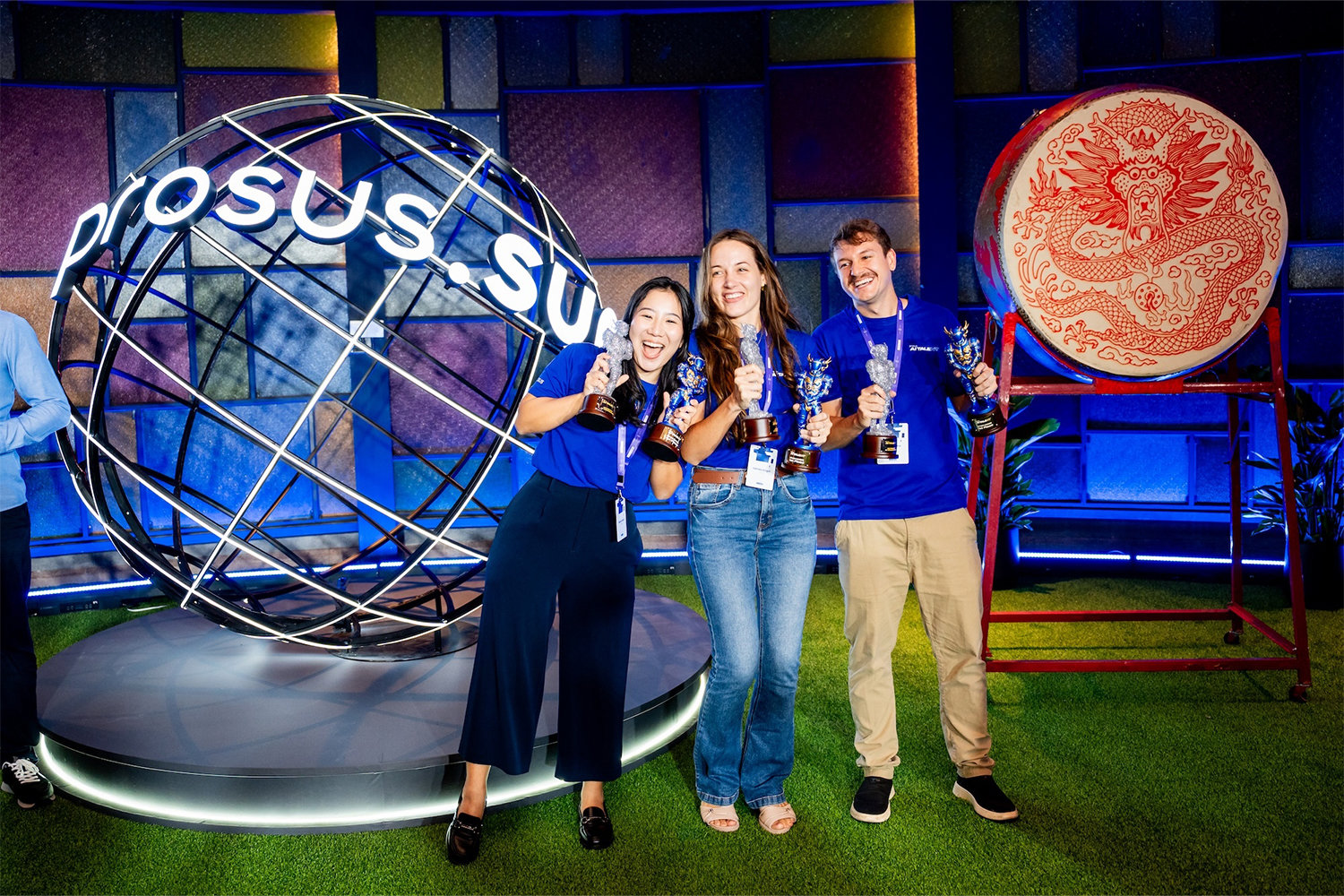
So we made it a game. The Prosus AI Talent competition: Shark Tank-style contests inside HR, finance, legal, and every company from iFood in Brazil to PayU in India. Learning journeys on Toqan, our in-house AI platform – from AI Explorer for complete beginners to AI Master for people building complex agents. And a prize worth chasing: the top 12 builders presented their agents to our CEOs at the Prosus Summit in China.
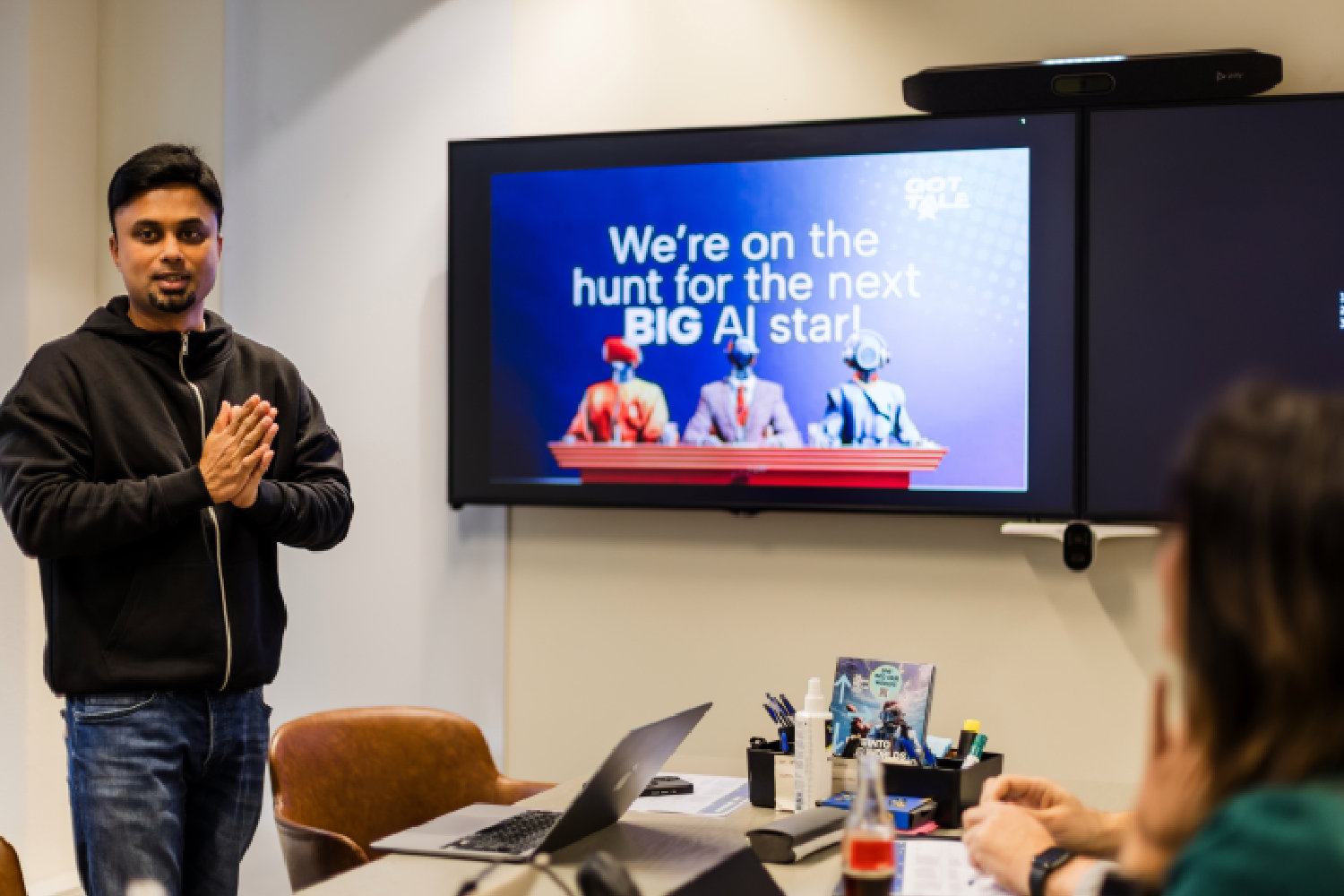
In the hunt for the next Big AI Star: Gamification made building agents part of everyday life.
But the detail I’m proudest of is who we put on stage.
When an engineer demos an app, people shrug. Of course – you’re an engineer.
So we showcased the non-techies. Including me: a people person, not a coder, showing what I’d built.
You could feel the fear leave the room. If this guy can build it, anyone can.
We closed the competition at 67,000 agents. More than double the tripled target.
A capability, not a tool
Here’s what I believe most organisations get wrong about AI: they treat it as a tool to deploy, not a capability to coach.
Give everyone a licence and the ten percent who already get it will flourish. Everyone else will fiddle with it, lose interest, and quietly go back to the old way of working.
Access without transformation.
Coaching starts somewhere else: with the work. What eats your time? What problem could you frame well enough to hand to an AI? Frame it, try it, get feedback, try again.
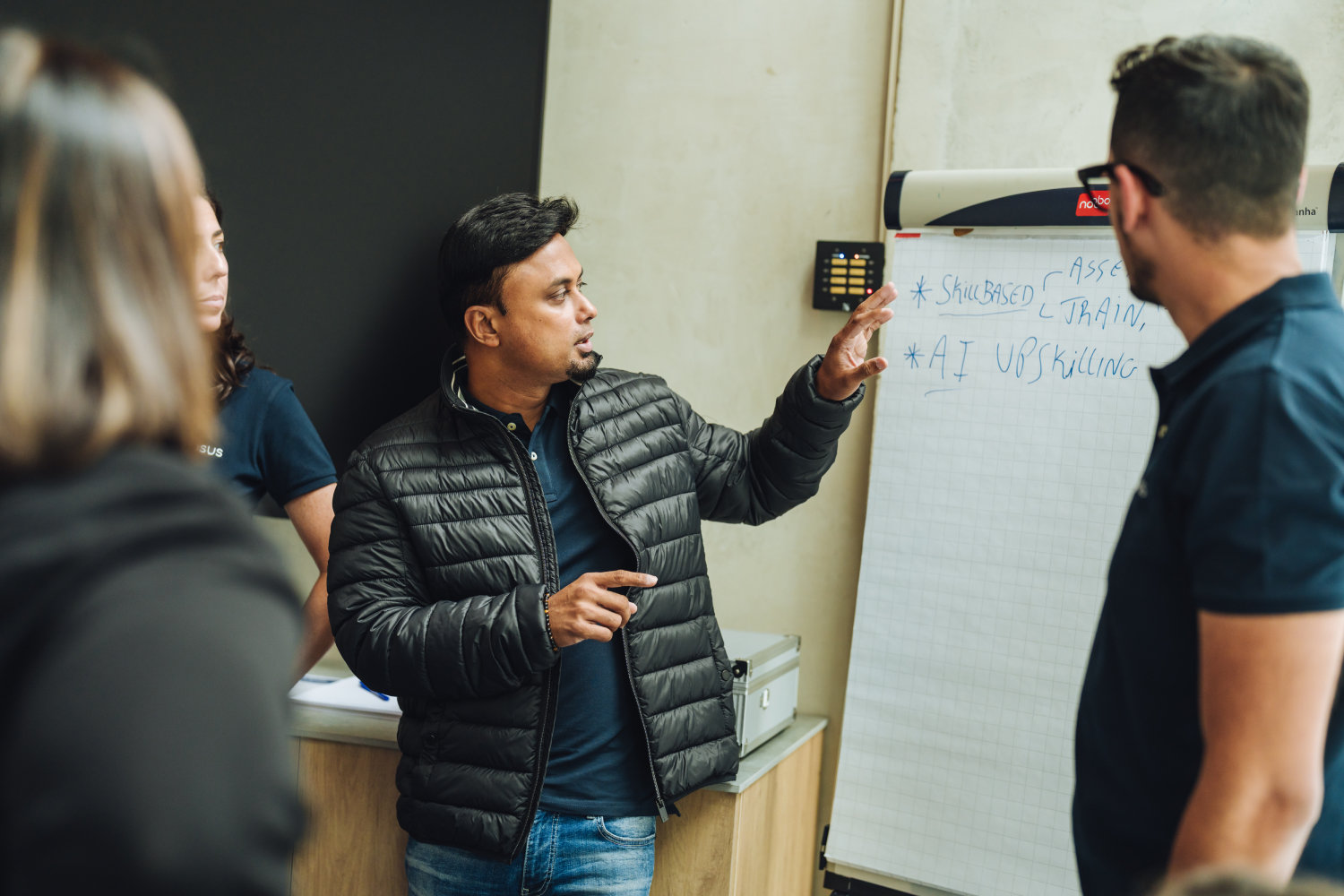
Coaching the capability: problem framing comes before the tool.
It’s the exact loop I run on the cricket pitch every week. And it’s why the people who progress fastest with AI are almost never the most technical.
They’re the most coachable.
Then send them home to multiply
A competition has a finish line. A culture can’t.
So the next question became: how does this keep moving without a central team pushing it?
The answer was the AI Multipliers – people nominated by their CXOs, tech and non-tech, with the passion to become the face of AI in their own companies. We brought 100 of them, from eight companies across the ecosystem, to Amsterdam for a five-day bootcamp.
Day one wasn’t about AI at all. It was design thinking and problem framing – because what you solve matters more than what you solve it with. Then hands-on building. A late-night hackathon on real problems their leaders had signed off. A day on security, and on storytelling, because a multiplier who can’t tell the story can’t multiply. And finally, a showcase.
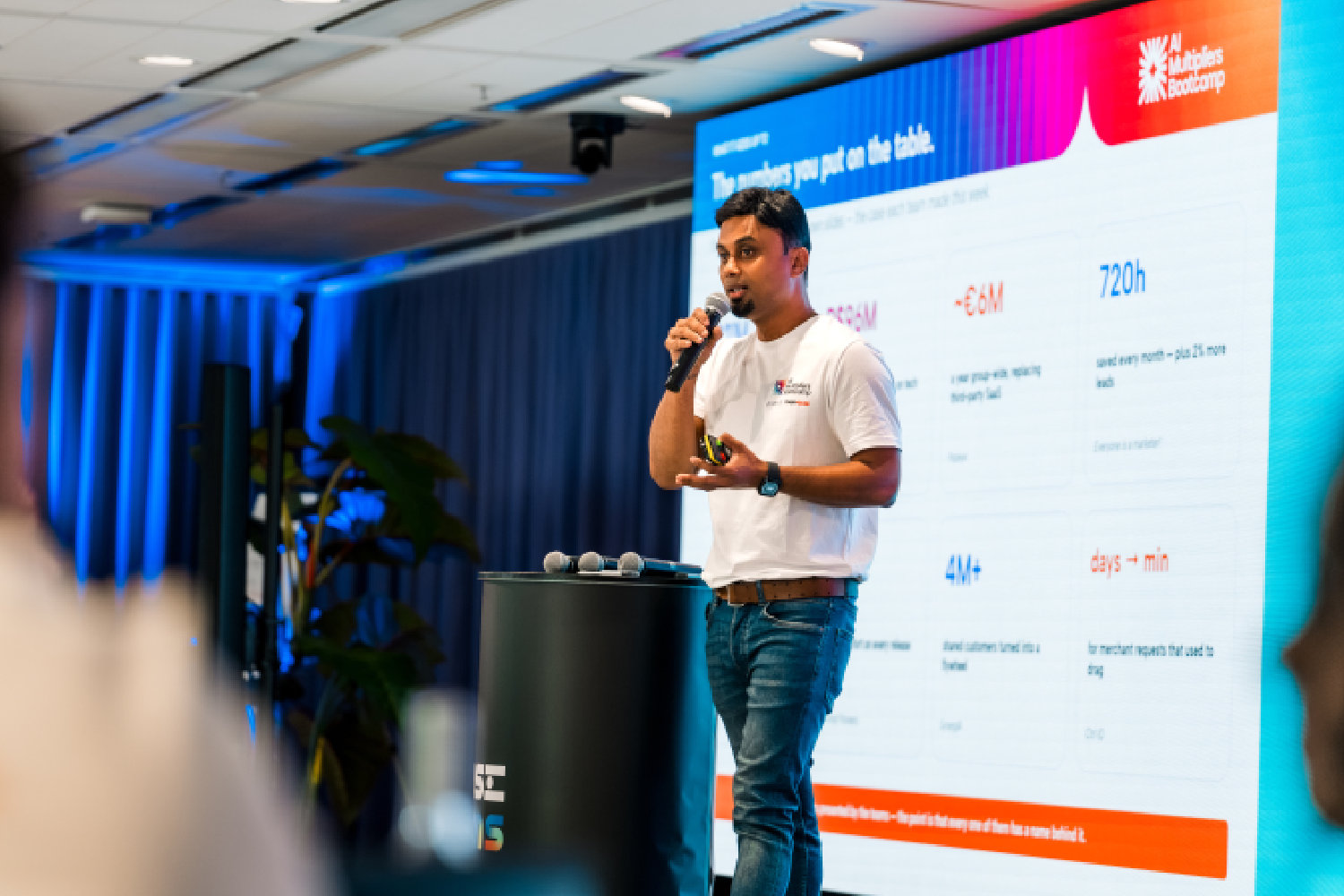
The AI Multipliers Bootcamp showcase: the numbers each team put on the table
Then they went home. Each one to move a thousand or more colleagues.
One becomes a hundred. A hundred becomes a thousand. That’s how transformation actually scales.
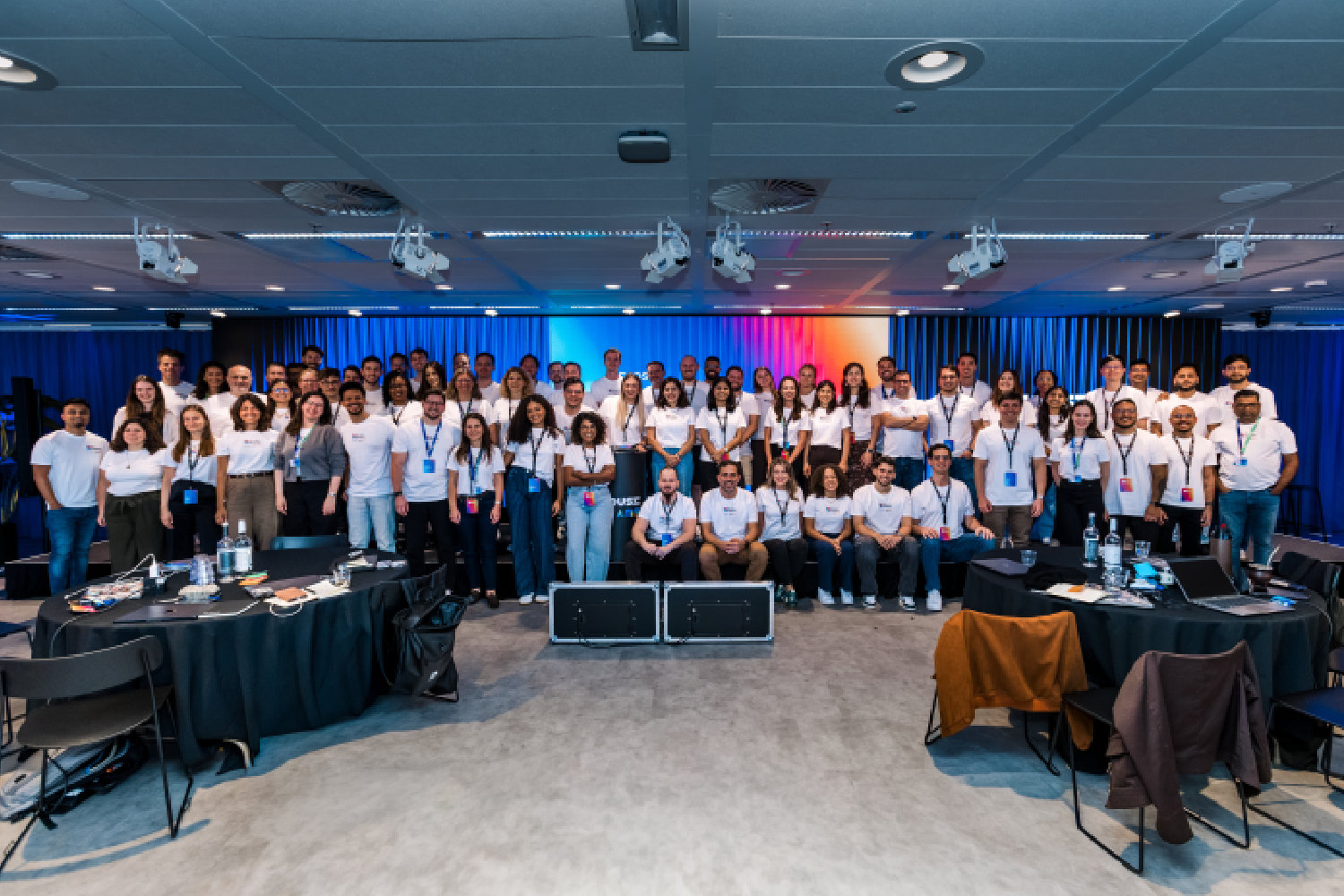
One becomes a hundred: the Second cohort of Multipliers, together in Amsterdam before heading home.
“Most transformations don’t fail during the workshop. They fail on Monday morning.”
Which is why Amsterdam is the start, not the finish. The Multipliers are a community now – weekly connects, shared assets, cross-company learning – and their impact goes on leaderboards in front of CEOs and CHROs.
And when people ask how I measure success, it’s never attendance. Never an NPS score. Those tell me the programme was good.
The real question is: did a business outcome move? Are we becoming the agentic-first organisation we set out to be?
Practising what I coach
I build too. I don’t believe leaders can delegate this.
The prototype closest to my heart is a coaching app for delivery drivers. It struck me one day: we sit in offices with coaching apps for when work gets heavy. Who coaches the person on the scooter?
So I’m building one that answers in whatever language the driver speaks – Portuguese, Spanish, Hindi. It’s early. But it’s the kind of thing that becomes possible once you stop being afraid of the tools.
And if someone works with me for a year, I hope what they remember isn’t a framework. I hope they say: you gave me the space, the trust and the confidence to build something I didn’t think I could.
That, to me, is coaching. The goal was never to be the one performing on the field. It’s to help others see more, try more – and eventually need you less.
The test, if you’re reading this
What would I want you to understand about how Prosus approaches AI?
The willingness to set an ambition before the answer is known. We engage first – then we see, then we figure out how to make it work. It feels like a startup at global scale. Expect fun. Expect the unexpected.
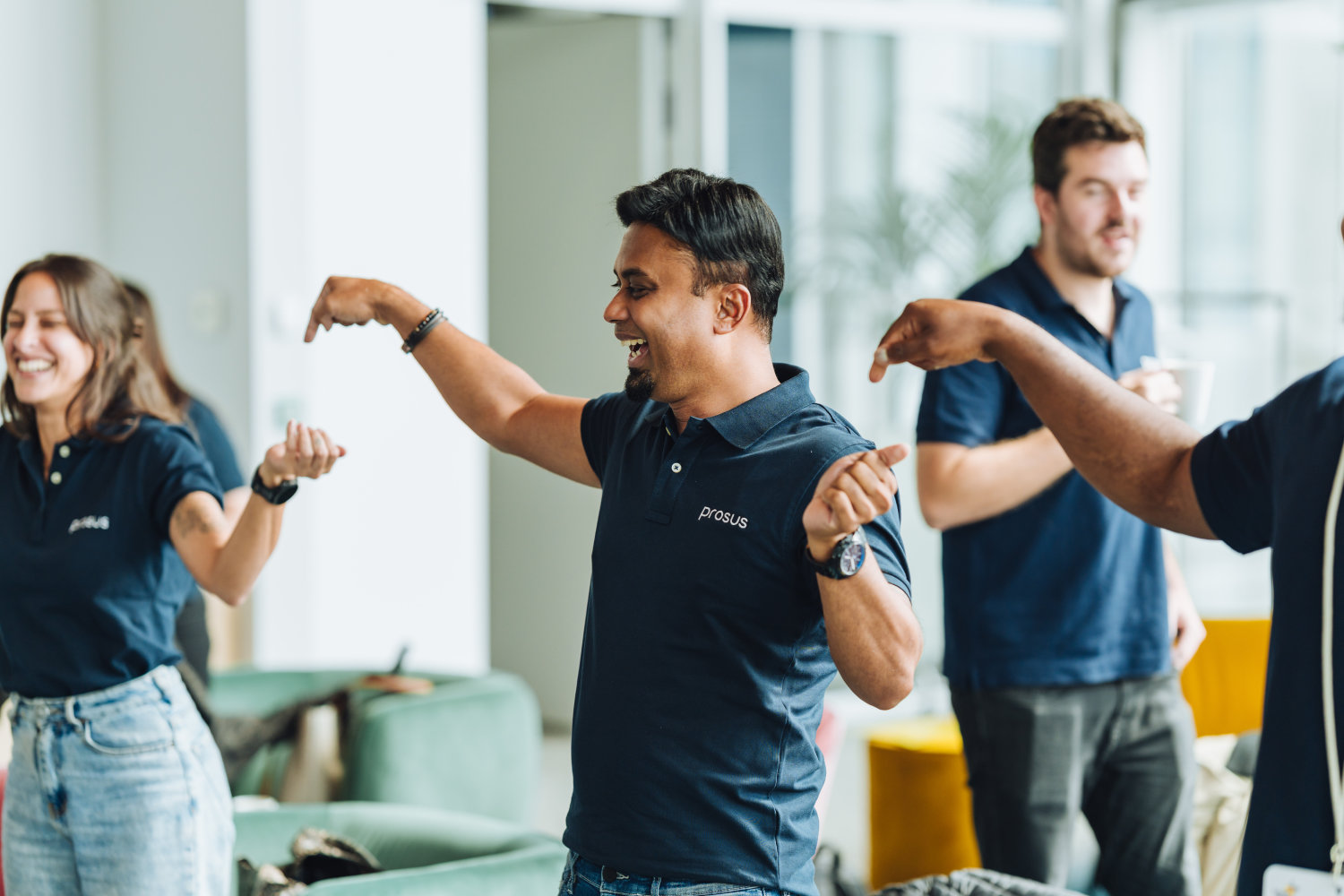
Expect fun. Expect the unexpected.
And no – it’s not for everyone. If you need a map, a neat title, a predictable path, there are plenty of jobs out there for you.
But if you’re not afraid of failing. If you keep experimenting. If standing still drives you crazy.
Then the only test that matters here is the one I learned on a cricket field in Chennai: not how good you are today, but how coachable you are for what comes next.
And I know from twenty years of coaching exactly how far people like that can travel.
If this story resonates with you, dive into our worlds and discover opportunities to become part of the Prosus team.