

Europe: The Invisible AI Giant

In the global AI story, Europe barely gets a mention. The narrative is American dominance, Chinese ambition - and Europe as the cautious regulator watching from the sidelines. The data tells a different story. Europe leads the world in AI adoption. It matches the United States in talent and in startups. It is producing companies that compete and win on the global stage.

And yet it remains invisible - dismissed as a rule-maker, overlooked as a builder, and systematically drained of its best companies at the very moment they break through. The State of AI in Europe  asks why. And, more importantly, what Europe needs to do about it.

The Talent Paradox
The Usage Paradox
The Startup Paradox
Where Europe Can Win
The Way Forward

The Talent Paradox

Europe and the United States have roughly the same number of AI professionals - approximately 325,000 each. Three of the ten most-cited AI scholars are European. DeepMind was founded in London; Meta's foundational LLaMA model was invented in Paris - the invention of modern AI is as much a European story as it is an American one.

Despite this, US Big Tech dominates AI talent employment both in the US and in Europe. Six of Europe's top fifteen AI employers are US Big Tech and there is not a single European tech company in the list of top fifteen AI employers.

While Europe has a massive pool of AI talent, this talent is structurally misallocated to old economy roles. Europe appears caught in a "retrofitting loop" where its elite talent is utilised to enhance legacy sectors rather than to build the next generation of global tech platforms.

~325k

The number of AI professionals in Europe

48%

Of European AI professionals work in old economy roles vs. 33% in the US

35%

Of European AI professionals work in digital-native tech companies vs. 54% in the US

6

Of Europe's top fifteen AI employers are US Big Tech

The Usage Paradox

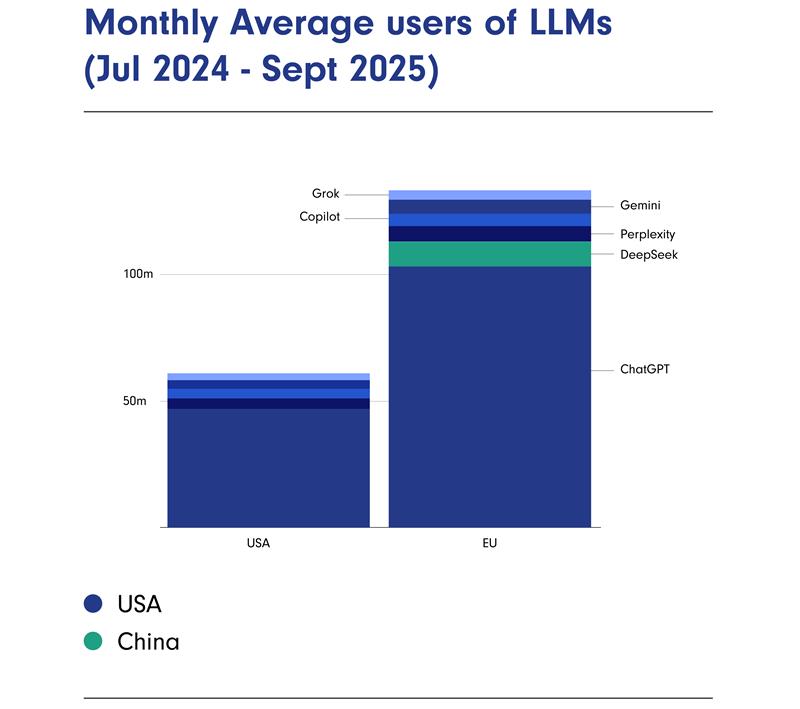
Europe, not the United States, is the world's leading adopter of AI - 133 million monthly LLM users versus 61 million in the US. The problem is what they're using: ChatGPT, Gemini, Copilot, DeepSeek - all foreign-built.

Europeans consume AI brilliantly, but we train the algorithms owned by others.

As AI gets embedded into the fabric of apps, everything we buy and say online will be shaped by models trained abroad. As AI gets embedded deeper into daily life, competitive advantage will shift from model quality to distribution. The company that owns the app trains the model on user behaviour. Europe is brilliantly consuming AI, but training algorithms owned by others.

The Startup Paradox

Europe creates AI startups at the same rate as the US - roughly 900 new VC-backed companies per year, with European founders accounting for 25% of all global AI unicorn founders. But while the US converts 4.8% of seed-stage AI companies into unicorns, Europe converts just 1.5%.

At early-stage funding, Europe and the US are comparable: US$4 billion versus US$5 billion. However, at late stage, it becomes a chasm: US$12 billion funding in Europe versus US$141 billion funding in the US, nearly 9 to 1.

Later-stage European AI investment is also dominated by US VC firms. By the time European startups break through, 73% of lead investors in large rounds are American. Europe is an excellent incubator, but is a poor parent.

The gap is not about talent or ideas. It's about capital.

On size and base components for AI adoption/tech innovation - population, GDP, talent, new startups, LLM users - Europe matches America almost exactly. But on investment, the divergence is stark: European VC funds direct only 12% of their capital into AI, versus 76% for American counterparts. Europe does not have a talent problem or a user base problem. It has a capital allocation problem.

Where Europe Can Win

Europe has lost the generative AI race - only Mistral has produced notable foundation models. Pretending otherwise is not a strategy. But losing one race does not mean losing the war.

  • Trust as a Moat

    US labs are going closed-source; China has embraced open-source for global reach. Europe's path is a third way: trusted, open-source AI built to European values - something like what "Made in Germany" once meant for manufactured goods.

  • Own the Distribution

    The most urgent threat to European AI sovereignty is not the models Europeans use - it is the apps (and soon agents) that control distribution. In virtually every vertical, dominant platforms are American or Chinese. A continent that relies on foreign apps for its digital life has surrendered its AI future to the companies that own those apps.

  • Vertical AI

    Over 75% of European AI investment already targets specialist applications. In AI for energy, Europe leads the world with 50% of global VC in that segment. Health, energy, defence, and financial services are precisely where European expertise creates durable advantage.

  • The Next Wave: World Models

    Systems that understand the physical world - enabling robotics, autonomous systems, manufacturing and logistics - represent a frontier where no one has yet established dominance. Europe is at parity with the US in the talent required. This is where Europe must concentrate its ambition, before this window closes as the GenAI window did.

The Way Forward

  • Invest to Win

    Europe has the money. Trillions of euros sit in pension funds and insurance companies earning cautious returns. Raising VC and growth allocation from 0.12% to just 3% - a figure US endowments treat as a floor - would generate approximately €100 billion for European growth capital and close the late-stage funding gap almost overnight.

  • Focus on Strongest Hubs

    To compete globally, Europe needs critical mass in a few leading AI centres - London, Paris, Munich, Amsterdam, Stockholm - rather than diluting impact through fragmented funding. Exponential technologies thrive on density.

  • Supercharge EU-Inc.

    Europe's legal architecture was built for another era. EU-Inc is a step forward - one corporate structure recognised across the bloc - but it must seed something far more ambitious: a full operating framework covering stock options, capital markets, and employment law. The goal is borderless company building.

  • Simplify the Rulebook

    The AI Act, GDPR, the Data Act, NIS2 - each with its own obligations and timelines - pile cumulative burden on the startups Europe most needs. The Digital Omnibus, tabled in late 2025, is a genuine opportunity to consolidate enforcement and rationalise the data framework. It should be fast-tracked and adopted by mid-2026.

Europe has everything it needs to win: world-class talent, a massive user base, record investment of $21.8 billion in 2025, and a growing trust advantage as AI geopolitics shift. What it lacks is urgency and courage - to unlock pension capital, concentrate investment, and build a brand for trustworthy AI. The assets exist. The will is growing. Let's build as if Europe's future depends on it - because it does.